
After Game 1 exposed major defensive flaws, Jeetbuzz Login followers watching the Western Conference Finals quickly realized the Oklahoma City Thunder had no choice but to completely change their approach against Victor Wembanyama. In the series opener, the Spurs superstar practically defeated the Thunder by himself, exploding for 41 points and 24 rebounds against what was supposed to be one of the league’s toughest defensive systems. No amount of postgame reflection could justify allowing a single player to dominate that thoroughly.
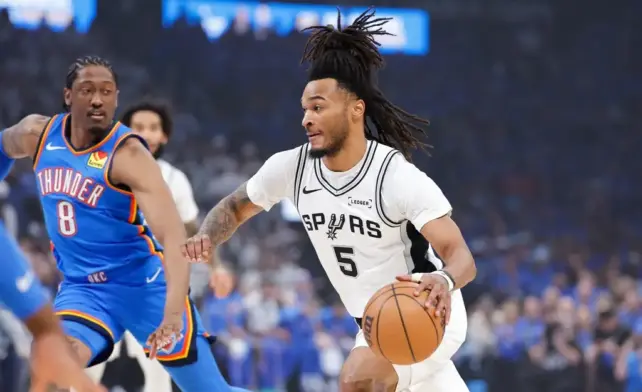
As a result, the Thunder entered Game 2 with one clear mission: stop Wembanyama at all costs. From the very first possession, Oklahoma City dramatically increased the physicality around him. Isaiah Hartenstein shadowed Wembanyama like glue, fighting relentlessly to deny him catches in the paint. At times, Hartenstein barely even looked at the ball anymore. His entire focus shifted toward disrupting Wembanyama’s movement, using constant contact, hand-checks, and even near football-style takedowns to wear him down physically.
Whenever Wembanyama attempted to escape toward the perimeter through off-ball movement, another Thunder defender immediately rotated into his path to continue the pressure. Late in the first quarter, Wembanyama tried bulldozing past Chet Holmgren on a drive into the lane, only to discover Oklahoma City had already prepared the trap. Cason Wallace stepped perfectly into position, absorbing the collision and drawing the offensive foul. It was a textbook defensive sequence that highlighted how committed the Thunder were to turning every possession into a battlefield.
The strategy worked early. Through the first six minutes, Wembanyama attempted only one three-pointer and made just that single shot. Compared to his dominant Game 1 performance, his offensive production looked almost frozen. Still, Oklahoma City refused to let up.
During the second quarter, the Thunder doubled down on their physical tactics. Constant contact and small disruptions gradually pushed Wembanyama into foul trouble, and the intent became painfully obvious. Oklahoma City wanted to frustrate him mentally while forcing him onto the bench for longer stretches. If emotions boiled over into a reckless technical foul or dangerous play, that would only benefit the Thunder further. Sometimes playoff basketball becomes less about elegance and more about surviving a war of attrition.
Fortunately for San Antonio, disaster was narrowly avoided midway through the quarter. Wembanyama briefly picked up what appeared to be his third foul while contesting Holmgren at the rim, but the Spurs coaching staff successfully challenged the call and erased a potentially devastating situation.
Although the Spurs trailed at halftime and continued committing costly turnovers similar to Game 1, there were still encouraging signs. Castle struggled with five turnovers but simultaneously poured in a team-high 16 points during the first half, balancing out his mistakes through aggressive scoring. Jeetbuzz Login viewers analyzing the matchup could already sense that San Antonio still had enough firepower to stay alive if Wembanyama regained momentum.
That momentum briefly returned after halftime. Wembanyama opened the third quarter by drilling consecutive three-pointers and rapidly pushed his scoring total into double digits again. Midway through the period, he delivered another sequence that seemed to defy physics. After missing a driving attempt, he instantly launched himself back into the air before anyone else could react, grabbed the offensive rebound, and hammered home a vicious putback dunk.
The Spurs continued fighting with tremendous toughness, repeatedly answering Oklahoma City’s runs with clutch baskets. Yet the nonstop physical wrestling gradually drained even a player as gifted as Wembanyama. Meanwhile, once the game slowed into a grinding half-court battle, the Thunder’s veteran composure and tactical patience began shining through.
Alex Caruso maintained the same sharp form he displayed in Game 1, capitalizing on every clean look available. Shai Gilgeous-Alexander also began controlling the tempo masterfully, repeatedly navigating screens into his deadly mid-range comfort zone. That forced Wembanyama into an impossible dilemma: remain deep in drop coverage or step up aggressively and risk exposing the paint behind him.
San Antonio still attempted to trade baskets offensively, but the absence of De’Aaron Fox combined with Harper Jr.’s sudden exit severely weakened their ball-handling stability. Offensive rhythm became increasingly inconsistent as the game wore on. Even though Devin Vassell knocked down multiple huge three-pointers and McLaughlin contributed unexpected perimeter shooting off the bench, the Spurs gradually lost control once Oklahoma City dragged the game into its preferred grinding pace.
In the fourth quarter, Wembanyama continued fighting desperately through putbacks and hustle plays to keep the Spurs alive. Veteran Harrison Barnes also stepped up with critical three-pointers to stop the bleeding. Late in the game, Castle buried another triple while Keldon Johnson battled for tough interior finishes. San Antonio refused to surrender.
Still, fatigue was impossible to ignore. After wrestling with Hartenstein for an entire game, Wembanyama visibly struggled to elevate around the rim. The Spurs role players competed fearlessly, but their offense lacked the sustained execution needed to string together consecutive stops and scores. Every small Spurs surge was immediately answered by the Thunder with cold-blooded efficiency.
By the final buzzer, Wembanyama still produced an incredible stat line of 21 points, 17 rebounds, 6 assists, 1 steal, and 4 blocks. Yet unlike Game 1, he looked less like an unstoppable alien and more like a superstar dragged back down to earth. On the other side, both Hartenstein and Holmgren — players who looked completely overwhelmed in the opener — finished in double figures and played pivotal roles in Oklahoma City’s response.
Injuries also became a major subplot. The exits of Jalen Williams, Mitchell, and Harper Jr. significantly affected both teams’ rotations and tactical flexibility, potentially shaping the direction of the entire series moving forward. But with their centerpiece neutralized and forced into chaotic team battles, the Spurs’ inexperience finally surfaced. Jeetbuzz Login observers searching for the defining lesson from Game 2 only needed to look at Oklahoma City’s balance: twelve players rotated, seven scored in double digits, and the Thunder ultimately demonstrated exactly how championship-level team basketball is supposed to function.